Straight answers: problems

Why Hiring More People Didn't Fix It

For the owner with a real team and a real payroll who still gets every question.

It's 4:40 on a Thursday. You have three texts waiting, two people standing at your door, and a quote that can't go out until you look at it. Eighteen months ago there were nine of you. Now there are fourteen. You hired so this exact afternoon would stop happening. It didn't.

You added people. Payroll went up. The questions, the checking and the fixing still land on you. So you typed some version of "I hired more people and I'm still doing everything" into a search bar. The people you hired are probably fine. Look at where their questions go. Every one of them has a single place to take a question, and that place is you.

This page shows you why that happens and what each kind of hire actually changes. Then The Org Chart puts your own company on one screen in about five minutes: every person, who they answer to, and how many of those lines end at you. You get that picture without firing anyone, without putting in another big system, and without giving up more of your week.

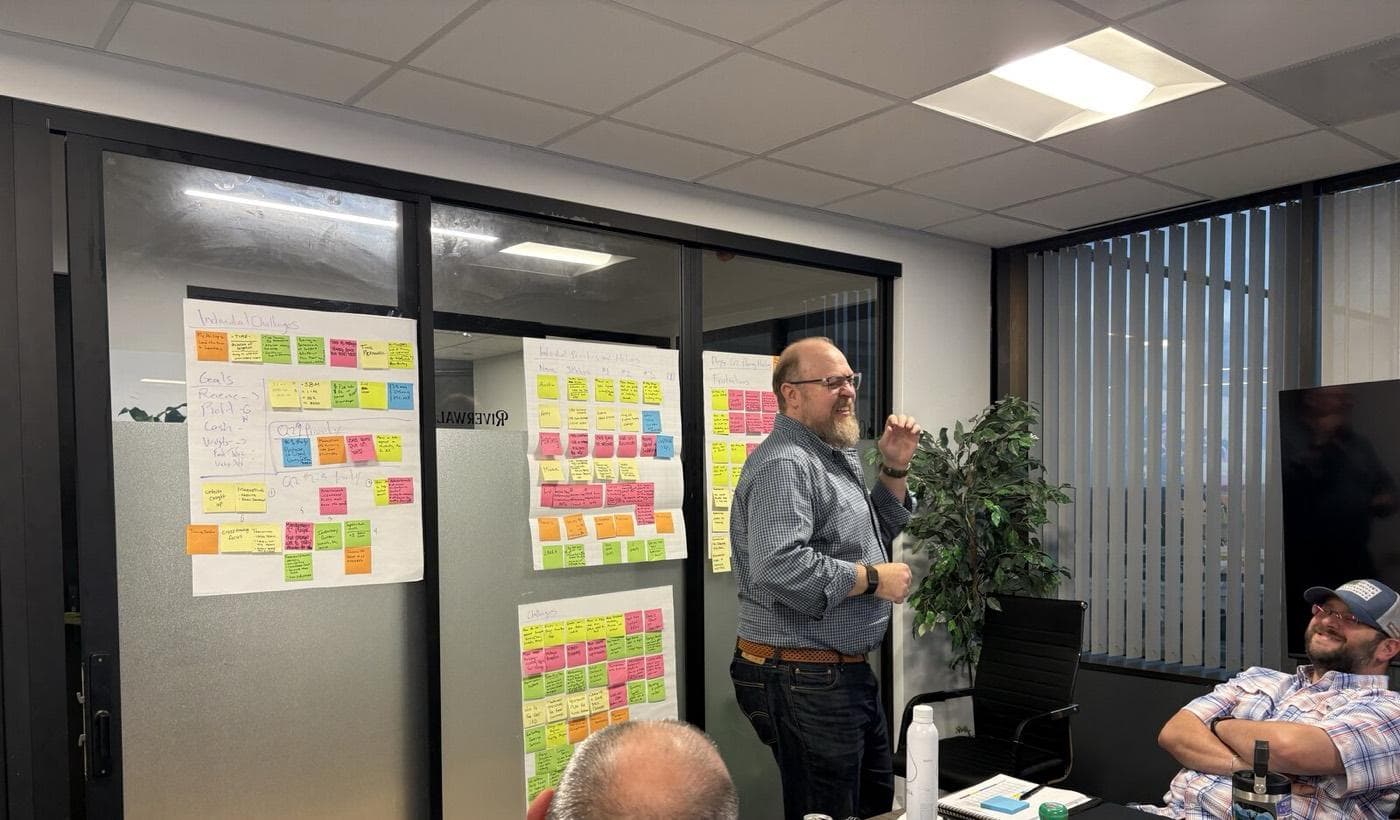
A man stands beside glass walls covered in rows of colored sticky notes while people sit around a conference table with notebooks and drinks.
Max Koz of Beyond 10 Million in a working session with a company's team.

What it is costing you

Start with the bill you can see. Payroll is higher than it was. That one shows up on a statement every two weeks.

The second bill doesn't print. Your week did not get shorter. Each person you added brought their own questions, and those questions came to you. You hired help, and now more people bring you questions.

The third bill is the one that hurts later. Your good people start waiting. They finish what they can, then they stand still until you look at it, approve it, or fix it. The best ones notice. Good people do not like to wait around.

None of this means you hired badly. It means every person you hired answers to you.

Four roads you have probably tried

Each one was a reasonable move. Here is why it made sense, and why the work still came back to you.

Hire another doer

The work was piling up, so you added hands. That is the right instinct when there is more work than people.

But the person you hired answers to you. Their questions come to you. Their mistakes come to you. Somebody has to check their work, so you do. You added a box to the chart and one more line that ends at your desk.

Hire a manager or a number two

This one should have worked, and it stings the most when it doesn't. You put a manager between you and the team.

But the team has known you for years, and you answer faster. So they keep coming to you, and you keep answering, because it takes ten seconds and you know the answer. Nobody told the team plainly that the lines moved. Nothing in writing says what the manager decides without you. The box is on the chart. The team's questions still come to you.

Promote your best worker

Your best technician, your best estimator, your best seller. They earned it, and promoting from inside is a fair way to treat people.

But doing the work well and running the people who do it are two different jobs. The risk is that you lose your best doer and get a manager who is still learning, with nothing written to learn from. The work they used to do needs somebody. The hard calls still come to you.

Work more hours yourself

This is the road with no hiring at all. You come in early, you stay late, you clear the pile on Sunday night. It works for a while, because you are good at this.

But it changes nothing about who the work comes back to. You are just there more hours to take it. And the team learns that waiting for you pays off.

What each fix changes on your chart

The same four roads, plus ours. On each one, read what still comes to you first.

Hire another doer

What changes on your chart
One more box, and one more line that ends at you.
What still comes to you
Their questions, their mistakes, and the check on their work. Plus everything that came to you before.
When it is the right call
When there is truly more work than your people can do, and someone other than you is there to answer their questions.

Hire a manager or a number two

What changes on your chart
A box between you and the team, on paper. The lines move only if you move them and stick to it.
What still comes to you
Whatever people still bring straight to you, plus the manager's questions about how you want things done.
When it is the right call
When the jobs under that manager are written down, and you are ready to send people back to the manager when they come to you.

Promote your best worker

What changes on your chart
Your best doer becomes a manager. Nobody is doing the work that person used to do.
What still comes to you
The work your best person used to do, and the calls a first-time manager is not yet sure about.
When it is the right call
When that person wants to manage, someone is ready to take over their old work, and both jobs are written down.

Work more hours yourself

What changes on your chart
Nothing. Same boxes, same lines.
What still comes to you
All of it, for more hours.
When it is the right call
For a short stretch with an end date, like a busy season or covering for someone who is out.

B10M, one play at a time

What changes on your chart
The same people, regrouped. Each person gets one named person to answer to and one written standard for the job. It adds no hands. If the work truly needs more people, you still hire.
What still comes to you
You approve every step of the play. The decisions only an owner can make stay with you.
When it is the right call
When the people are mostly there and the questions still all come to you. It is the wrong call if you are simply short of hands.
This is our judgment, not a score and not a study. It reads each fix by what it does to the lines on a chart, and your company will differ. Our own row is held to the same test as the others. Nothing here promises a result.

See your own lines. The Org Chart takes about five minutes.

Build your org chart

Give every question somewhere else to go

A question goes to the owner when it has nowhere else to go.

So every person on the chart needs two things. One named person they answer to. One written standard for the job, so they know what good looks like without asking you.

People say "just delegate." Delegate to whom, and against what standard? With those two things, a question has somewhere to go besides you. Without them, no hire changes anything, because the person you add has the same single place to take a question as everyone else.

How many lines should end at you? There is a rule of thumb. Purdue Extension, in its guide to structuring small businesses and farms, puts the typical guideline at no more than five to six people answering to one manager. It adds that more is possible, depending on how complex, how varied and how close together the jobs are.

The same guide says owners of family businesses run into this a lot: the business grows, people are added, and the owner still wants everyone reporting to him or her.

Entrepreneur magazine said it plainly in a 2001 article by Mark Henricks: "If you have more than half a dozen people reporting to you, it could be too many."

That article tells the story of Pat Harpell, who ran a marketing services firm and had 18 people reporting directly to her. She hired middle managers. Three years later the firm had 60 employees and she had six direct reports. Her words: "My biggest value to the company was to work on it, not in it day to day."

Look at what moved in that story. She did add managers. But the number that changed her week was the lines ending at her, from 18 to six. She is not a client of ours, and one company's story is not a forecast. It tells you where to look. Count the lines first. Then decide what to hire.

Now count yours. The Org Chart takes about five minutes.

Build your org chart

One play at a time

B10M is the AI-aided implementation of the 7 core plays that grow a company. A play is one specific thing to fix in the business. You work on one at a time, never all seven.

We call the way of choosing it The One-Play Method. It has three steps: find the lowest one, move it up one level, repeat. The "one" is one of the seven plays, the one that is weakest in your company right now.

On this page, the play is the one about who does what and who answers to whom. AI drafts the first pass of the work. You approve every step. Someone on your team can run it day to day.

The method behind the plays is proven over 30 years in business and 17 years helping small companies.

If you are weighing outside help, the options are compared in EOS, Scaling Up, Vistage, a fractional COO, or doing nothing.

If your chart looks right and the work still finds you, read Why Everything Still Comes Back to You, Even With a Team.

Before you buy outside help for this, check whether it is built for a company your size.

What the record shows

Here is the record of Max Koz of Beyond 10 Million with clients, in his words: about half of clients grew revenue 2-3x; 45 of 50 had significant positive movement.

One of them, a veterinary practice, went from $2M at 9% net to $6M at 30% and sold for about $13 million.

Take those for what they are. They are what happened for those owners. They are not a forecast for your company, and an org chart did not do it alone. They are here so you know the method has been used on real companies.

Sample: one company's chart, before and after

This company is made up. It is here to show you what to look for on your own chart: the same people, drawn two ways.

Sample

Mesquite Flats Heating and Air regroups 13 people

Mesquite Flats Heating and Air is a made-up company. It is not a client, and these are not client numbers.

Before: 13 people, 13 lines to the owner

  • The office manager, the dispatcher and the bookkeeper each answer to the owner.
  • Both salespeople answer to the owner.
  • Two crew leads have the title. All six technicians still call the owner.
  • Nothing about any job is written down.

After: the same 13 people, 5 lines to the owner

  • The dispatcher and the bookkeeper answer to the office manager.
  • Three technicians answer to the service lead, three to the install lead.
  • The office manager, the two leads and the two salespeople answer to the owner.
  • One empty box: a sales lead, a job nobody is in yet.
Sample only: not client data, and no result is promised. Nobody was hired and nobody was let go. Each job in the second chart also gets one written standard. Drawing the lines is the start. The harder part is getting people to use them every day.

The short version

  • Hiring adds people. It does not change who they answer to, so the questions still come to you.
  • A manager only helps if people actually answer to the manager and the job is written down.
  • Count the lines that end at you. Purdue Extension's typical guideline is no more than five to six.
  • The fix is one named person to answer to and one written standard for every job.
  • If the work truly needs more hands, hire. Fix the lines first, so that person has somewhere to go.

This page has two goals, and you should know both. The first is to be useful even if we never talk: count your lines, read the chart above, and fix it yourself. The second is to show you where to go if you want help. Start with The Org Chart. If you want help after that, apply.

Frequently asked questions

Does hiring more people ever fix it?

Yes, when the problem is more work than people. If your team is flat out and the work is good, you need more hands. It does not fix a week where every question comes to you, because each person you add brings more questions to the same place. Check who they would answer to before you post the job.

I already hired a manager and it still comes to me. Why?

A manager on the chart is not the same as people answering to that manager. If the team can still come straight to you and get a faster answer, they keep doing it. Look for two things: whether the team was ever told plainly who they answer to, and whether anything in writing says what the manager decides without you.

How many people should answer to me?

There is no exact number. Purdue Extension gives the typical guideline as no more than five to six people for one manager, and says more is possible depending on how complex, varied and close together the jobs are. Entrepreneur magazine put it as a rule of thumb in 2001: more than half a dozen could be too many. If your count is well past that, start there.

I am too small for an org chart

A chart is only a picture of who answers to whom, and that exists in your company today whether anyone drew it or not. At six or eight people it is already worth seeing. If they all answer to you, you are at or past the five to six people Purdue Extension gives as the typical guideline. Drawing it takes about five minutes.

I do not have time for this

The first step is about five minutes on The Org Chart, and it asks for nothing but names and who each person answers to. What you do after that is your call. If your time is going to questions that should never reach you, five minutes to see that is a fair trade.

I tried EOS and it did not stick

We can't tell you why it did not stick in your company, and we won't guess. What we can say is that any full system asks your team to keep many things running at once, while the daily questions still come to you. B10M works on one play at a time, never all seven, and you approve every step. If your trouble is who answers to whom, start with that one thing and look at your chart first.

Sources

Sources checked October 11, 2026. The guideline numbers are theirs. The reads in the chart and everywhere else on this page are our judgment, not a study and not a promise.