Straight answers: problems

Why Everything Still Comes Back to You, Even With a Team

For the owner who has a team and still gets every question, every approval and every fix.

It's Saturday, a little after ten. You are in a folding chair at your daughter's soccer game, and your phone has buzzed four times since kickoff. A tech wants to know which part to order. A quote is waiting on your yes. A customer is unhappy and will only talk to you. You answer all three before halftime, and you miss the goal.

You have a team. Good people, mostly. And the questions, the approvals and the fixes all still find you, at the shop or away from it. So you typed some version of "I have a team, why does everything still come back to me" into a search bar. The usual answer is that you can't let go. That is not how it feels from the folding chair. It feels like nobody else can answer.

By the end of this page you can sort what comes back to you into five kinds, and see why each kind comes back. Then The 90-Day Test tells you, in about five minutes, how long the company would run without you and the one thing to hand over first. You get both without replacing your people, without writing a manual for everything, and without giving up more of your week.

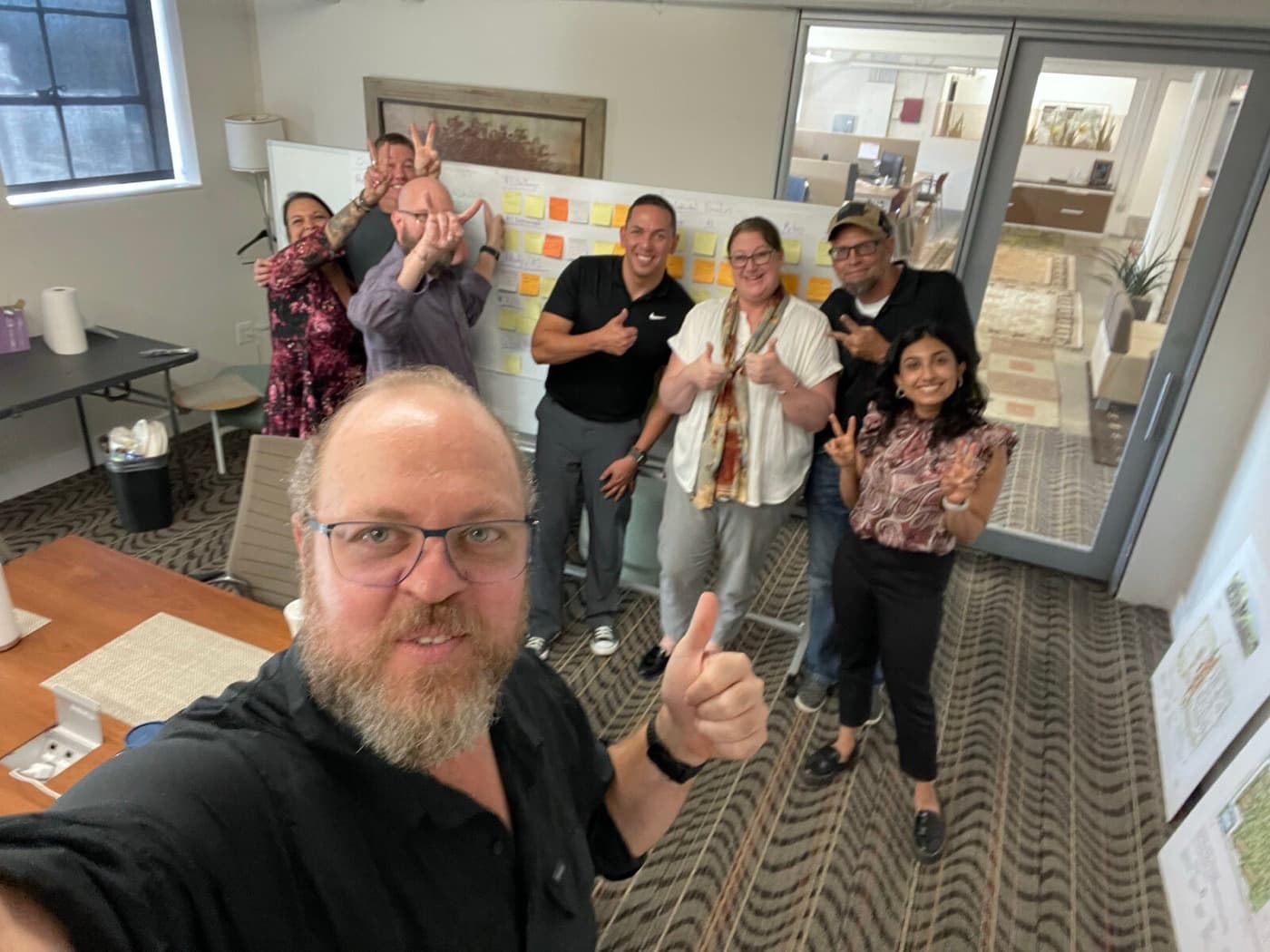
A bearded man in glasses takes a selfie with a thumbs up while six people stand behind him, smiling, in front of a wall covered in colored sticky notes.
Max Koz of Beyond 10 Million takes a selfie with a company's team in front of a wall of sticky notes, after a working session.

Where your day goes

Add up a normal day. Most of it goes to answering. Somebody needs a yes. Somebody needs to know how. Something came back wrong, and it is quicker to fix it than to explain it.

Your own work waits. The work only the owner can do, like the big customer, the pricing, the bank, and where the company goes next, gets done at night after the kids are down.

Your team waits too. They finish what they can, then they stand still until you answer. The good ones do not like standing still.

And you can't be gone. Not for two weeks, and some days not for one soccer game. The 90-Day Test asks it straight: "If you disappeared for two weeks tomorrow, phone off, what actually happens?"

You are not unusual. Gallup reported in its Business Journal in 2015 that 75% of the employer entrepreneurs it studied have limited-to-low levels of what it calls Delegator talent. By Gallup's measure, most of the owners it studied find this hard.

What comes back is five kinds of work

Most advice treats "everything comes back to me" as one problem with one fix. It is not one thing. Look at your texts from last week and sort them. They fall into five piles, and each pile comes back for its own reason.

A question about how to do it

Which part, which vendor, what do we charge for this. It takes you ten seconds, so you answer.

It comes back because the answer lives only in your head. Your people are not being lazy. They ask you because you are the only one who knows.

A decision that waits for your yes

The refund, the discount, the overtime, the purchase. The person asking usually knows what they would do.

It comes back because nobody was told they may decide. With nothing saying what is theirs to approve, asking you is the safe move. You would do the same in their shoes.

A job that came back wrong, so you fix it

The estimate with the wrong number. The report that missed the point. You fix it yourself because that is faster than sending it back.

It comes back because the standard was never written, so you are the check. Your people can't meet a standard nobody ever showed them. And every fix teaches the team that close is enough, since you finish it.

A customer who only wants you

The big account that has your cell number. They are polite to your team, and then they call you.

It comes back because the relationship is yours alone. You won that customer, and nobody else was ever put in front of them as someone who can say yes.

Two of your people at odds

Sales promised a date the shop can't hit. Each one tells you their side, separately.

It comes back because nobody else was named to settle it. The 90-Day Test asks about this pile too: "When two of your people have a problem with each other, what happens?" If the plain answer is "they come to me," this one is yours.

The 90-Day Test shows the one thing to hand over first, in about five minutes.

Take the 90-Day Test

Four things you have probably tried

None of these is a hire, and each one was a reasonable move. Here is why it made sense, and why the work still came back.

Tell them to "just handle it"

You trust them, and you said so. That is the right instinct.

But "handle it" does not say what they may decide, or what a good answer looks like. So they guess. The first time a guess goes wrong and you step in, they learn to check with you first. After that, they ask you before they do anything.

Write everything down

Somebody told you to document everything, so you started. It makes sense, because the answers do live in your head.

But you never finish it. "Everything" has no order and no end, and you are the only one who can write it, at night. A how-to also covers one pile only. It does not say who may decide, who checks the work, or who settles a fight.

Add a meeting or more check-ins

If the questions come all day, give them one place to go. Fair enough.

But the meeting does not change who answers. It collects the same questions and brings them to you all at one time. The work waits for Tuesday, and the urgent ones still come by text.

Do it yourself because it is faster

It is faster. Today, you are right.

But you will spend the same ten minutes next week, and the week after. The person who would have learned it did not. And the team sees that hard things go to you.

What each one changes, and what still comes back

The same four, plus ours: Beyond 10 Million (B10M). On each one, read what still comes back to you first.

Tell them to "just handle it"

What changes for your team
They are told to decide, with nothing saying what they may decide or what good looks like. Most guess, or ask you anyway.
What still comes back to you
The hard calls, the fixes when a guess goes wrong, and the same questions a week later.
When it is the right call
When the person has done this exact job many times and already knows your standard.

Write everything down

What changes for your team
They get a binder or a folder of how-tos. Few read it, and it goes stale as the work changes.
What still comes back to you
Every decision, since a how-to does not say who may decide. Plus every question the binder did not cover.
When it is the right call
When you write down one kind of work at a time, starting with the one that comes back most, and someone other than you keeps it current.

Add a meeting or more check-ins

What changes for your team
They save their questions for the meeting. Work waits for the day it happens.
What still comes back to you
The same questions and approvals, all in one hour. The urgent ones still come by text.
When it is the right call
When the meeting has one purpose and someone other than you can make the calls in it.

Do it yourself because it is faster

What changes for your team
Nothing, except they learn that hard things go to you.
What still comes back to you
All of it, and a little more each month.
When it is the right call
When it is truly a one-time job, or something only the owner should do.

B10M, one play at a time

What changes for your team
One kind of work gets a named person who is allowed to decide and a written standard. It does not take the work off you in a week. It moves one kind at a time.
What still comes back to you
Everything in the other kinds, while the first one moves. You approve every step. The decisions only an owner can make stay yours.
When it is the right call
When the people are mostly right and the work still finds you. It is the wrong call if you want it all gone by next month.
This is our judgment, not a study and not a score. Your company will differ. Our own row is read the same way as the other four, including what it does not do. Nothing here promises a result.

Hand over the job and the right to decide

Go back through the five kinds and their reasons. They look different. The same two things are missing each time.

A named person who is allowed to decide. And a written standard for what good looks like.

The question needs someone else who knows the answer. The approval needs someone told, in plain words, what they may say yes to. The fix needs a standard on paper, so the person doing the job can check it before you ever see it. The customer needs a second name they trust. The disagreement needs someone named to settle it.

That is where most owners get caught. They hand over the job and keep the right to decide. Purdue Extension, in its guide to structuring small businesses and farms, describes the owner who still wants everyone reporting to him or her "rather than delegate responsibility and authority to a middle manager."

Look at those two words. Responsibility is the job. Authority is the right to decide. Hand over the job without the right to decide, and they still have to ask you before they finish it.

Not all five at once. Five kinds, each needing a person and a standard, is too much to start together, and you are the one who would be doing it. Pick one kind. Move it. The other four keep coming to you while you do, and that is fine.

Which one goes first in your company is what The 90-Day Test is for.

Take the 90-Day Test

Why one, and which one

B10M is the AI-aided implementation of the 7 core plays that grow a company. A play is one specific thing to fix in the business. You work on one play at a time, never all seven.

The way of picking it is called The One-Play Method, and it has three steps: find the lowest one, move it up one level, repeat. The "one" is one of the seven plays, whichever is weakest in your company right now.

On this page, the play is the one about who does what and who is allowed to decide. AI drafts the first pass of the work. You approve every step. Someone on your team can run it day to day.

If your question is more about the people you added and why that changed nothing, read Why Hiring More People Didn't Fix It.

If you are weighing outside help for this, the options are laid side by side in EOS, Scaling Up, Vistage, a fractional COO, or doing nothing.

If you are weighing outside help for this, start with whether it is built for a company your size.

What has happened for other owners

The method is proven over 30 years in business and 17 years helping small companies.

Here is the record of Max Koz of Beyond 10 Million with clients, in his words: about half of clients grew revenue 2-3x; 45 of 50 had significant positive movement.

One of them, a veterinary practice, went from $2M at 9% net to $6M at 30% and sold for about $13 million.

Those are what happened for those owners. They are not a forecast for yours, and sorting what comes back to you did not do it alone. They are here so you know the method has been used on real companies.

Sample: one owner's Tuesday, sorted

This owner and this company are made up. They are here to show you what sorting looks like, so you can do it with your own day.

Sample

One Tuesday at Caliche Creek Roofing

Caliche Creek Roofing is a made-up company, and Dale, its owner, is made up too. This is not a client and not a client's day.

Before: what reached Dale on Tuesday

  • A question: the crew lead calls to ask which underlayment goes on the school job.
  • A decision: a change order sits all day waiting for Dale's yes.
  • A fix: an estimate has the wrong measurements, so Dale redoes it that night.
  • A customer: a property manager has a leak and will only talk to Dale.
  • Two people at odds: the estimator and the production manager both text Dale about who schedules the crews.

After: the same five, each with somewhere to go

  • The question goes to a written spec for that kind of roof, kept by the production manager.
  • The change order goes to the production manager, who may approve up to a limit Dale put in writing.
  • The estimate gets checked against a written checklist by the lead estimator before it leaves.
  • The property manager is introduced to a named account person, and still has Dale's number for the big things.
  • The scheduling fight goes to the office manager, named in writing as the one who settles it.
Sample only. No result is promised and no hours are counted. In a real company you would not move all five at once. You would pick one kind, give it a named person and a written standard, and let the other four keep coming to you while it settles.

If you only read this part

  • What comes back to you is five kinds of work: questions, approvals, fixes, customers who only want you, and your people at odds.
  • Each comes back for its own reason. The answer is in your head, nobody was told they may decide, the standard was never written, the relationship is yours alone, or nobody else was named to settle it.
  • "Just handle it," writing everything down, more meetings and doing it yourself each leave at least one of those reasons untouched.
  • A kind of work can stop coming back once it has a named person who is allowed to decide and a written standard for what good looks like.
  • Not all five at once. Pick one, and let the rest keep coming to you while it moves.

This page has two goals, and you should know both. The first is to be useful even if we never talk: sort one day of what comes back to you, pick one kind, and give it a named person and a written standard yourself. The second is to show you where to go if you want help. Start with The 90-Day Test. If you want help after that, apply.

Frequently asked questions

Why does everything still come back to me when I have good people?

Because good people still need two things they may never have been given: the right to decide, and a written standard for what good looks like. Without those, asking the owner is the safe and sensible move. And what comes back is not one thing. It is questions, approvals, fixes, customers and disagreements, and each one comes back for its own reason.

It is faster to do it myself. Why would I hand it over?

It is faster today, and you are right about that. But the ten minutes you spend today is the same ten minutes next week, because nobody else learned it. Handing it over costs more time the first few tries, and that is what it takes for someone else to learn it. Keep doing it yourself when the job is truly a one-time thing or something only the owner should do.

What should I hand over first?

One kind of work, not all five. A fair place to look is the kind that comes back most and that someone on your team already knows how to do. The 90-Day Test names the one thing to hand over first in your company, in about five minutes. Whatever you pick, give it a named person who may decide and a written standard.

Nobody does it as well as I do

That is probably true today, and it is common. Gallup reported in 2015 that 75% of the employer entrepreneurs it studied have limited-to-low levels of what it calls Delegator talent, and it describes non-delegators as people who do not trust others to do things as well as they can. The question to ask is whether your standard is written anywhere. If it lives only in your head, nobody can match it, however good they are.

I do not have time for this

The first step is about five minutes on The 90-Day Test, with nothing to look up. After that, the work is one kind at a time, not a big project on top of your week. If your days are going to questions that should never reach you, five minutes to see where to start is a fair trade.

I tried EOS and it did not stick

We can't tell you why it did not stick in your company, and we won't guess. A full system asks your team to keep many things running at once, while the daily questions still come to you. B10M works on one play at a time, never all seven, and you approve every step. If your trouble is that everything comes back to you, start with one kind of work and one named person.

Sources

Sources checked October 13, 2026. The quoted words and the percentage are theirs. The reads in the chart and everywhere else on this page are our judgment, not a study and not a promise.