
Anyone could do it on day one
- About what it is worth
- About $15 an hour
- Jobs like this
- Parts and supply runs, restocking shelves, cleaning the shop, picking up from the vendor
- Who should usually do it
- A new hire, a runner or a part-timer
Straight answers: problems
Why Pay Divided by Hours Gets It Wrong, and What to Use Instead
This page is for the owner with a team who still spends his evenings on work he could pay someone $15 an hour to do.
It is 9pm and you are at the kitchen table redoing an estimate your estimator sent over this afternoon. It is quicker to fix it than to explain it. Earlier you drove a box of fittings across town because nobody else could get away. And an email from the biggest account you could land this year has sat unanswered since Tuesday.
So you looked up what your time is worth and found a formula: what you earn divided by the hours you work. The number was small, and it made the drive across town look like a fair use of your afternoon.
That number is what you are paid per hour. It is not what your hour is worth. This page shows how to find the second number and which hours to hand over first, the same way Max Koz draws it on the whiteboard for owners.
Say you pay yourself $50 an hour. Every hour you spend on a job you could pay someone $15 an hour to do, the business pays $50 for $15 of work. That is $35 gone every hour, and nobody sends you a bill for it.
Max says it with a $10 job: "If you're getting paid $50 an hour, and you're doing a $10 an hour job, you're costing the business money."
Ten hours a week of that is $350 a week, or $17,500 over 50 working weeks. The bigger cost is the work those hours were not spent on, like the account that has waited since Tuesday. Nobody calls or texts you about that work, so the jobs people do call and text you about get your hours first.
James Clear lays out the usual method: "Finally, divide your total money earned (Step 2) by your total time spent (Step 1)." His example: "If you make $100,000/year, your time is worth $40.00/hour." That works for someone on a salary. For an owner it has two problems.
First, most owners underpay themselves, because they pay everyone else first. With a low number, $15 work looks like a fair use of your time, so you keep making the parts runs yourself.
Second, it gives every hour the same price. An hour restocking shelves counts the same as an hour with your biggest customer, so the formula cannot tell you which hours to move.
Clear also names a "Cost-Based Method": "the rate you would pay someone else to do the work that you do." This page uses that method, done job by job instead of for the whole week.
Some of your hours are worth about $15: the parts run, restocking, redoing someone's work. Some are worth $35. A few are worth far more: selling the big account, choosing where the company goes, building something your team can run without you.
Max starts with one question: "Think about what is the most valuable thing that you do and how much would you have to pay someone per hour to do that work." Then he asks it of every job in your week.
Price each job at what you would pay someone per hour to do it well, and count your hours on each. The jobs that take the most hours count the most. Add it all up and you get what your hour is worth today.
Every job priced below what you pay yourself costs the business the difference. Start with the lowest one and put those hours on your most valuable job.
Your list will not look like anyone else's. Price your own week in the free tool.
Price my weekEach of these made sense when you did it, and each one still leaves work on your desk.
Working more hours paid off when the company was small. But the new hours go to whatever is loudest, and that is rarely the valuable work. You add a Saturday and spend it on invoices, and your health or your family pays for it.
That is probably true. But the job only has to be done well enough for what it is worth. Someone else doing a $22 job nearly as well as you, while you do the $100 job, beats you doing both.
You hire a good person to take things off your plate. With no list of which jobs to give them, they get whatever you think of that week. You still do the low jobs, because explaining takes longer. Three months in, you wonder why you hired them.
If you already hired help and the work did not move, read Why Hiring More People Didn't Fix It.
If the low jobs keep landing back on you after you give them away, read Why Everything Still Comes Back to You, Even With a Team.
Not sure what a job is worth? The tool starts you with these five levels. The jobs listed are from a trades or retail company.
| Option | About what it is worth | Jobs like this | Who should usually do it |
|---|---|---|---|
| Anyone could do it on day one | About $15 an hour | Parts and supply runs, restocking shelves, cleaning the shop, picking up from the vendor | A new hire, a runner or a part-timer |
| Needs some training | About $22 an hour | Answering the phones, scheduling crews, entering invoices, ordering stock | Office staff or a trained team member |
| Needs real skill or trust | About $35 an hour | Writing estimates, the skilled work itself, calming an upset customer, handling the cash | Your experienced people and your leads |
| Needs a manager or an expert | About $60 an hour | Running the crews or the floor, hiring, training leads, reviewing the numbers each month | A manager, or an outside expert for the narrow jobs |
| Only the owner can do it, and it grows the business | About $100 an hour | Winning the big account, setting prices, choosing where the company goes, setting up the systems others run | You |

Two are from Max's work with owners. The third is a question he asks them.
Max drew it on the board for an attorney who owned his firm, and asked him what the most valuable thing he could do was.
The attorney said opening new locations. Then he looked at the board and said the rest out loud: "I can hire attorneys. We've got systems. I shouldn't be doing this work."
He went and opened four new locations, and did a lot better than he had doing the legal work in one. It was good work, just not the most valuable work he could do.
A client's brother worked in the family business, and he asked for a raise: "I'm doing all these different types of work, I should get paid more."
Max suggested a time audit: where his hours go and what each hour is worth. Priced out, the average showed he was already paid more than his hours were worth.
The way to the raise was to do more of the high-value work, and that was not the work he wanted to do. It ended in a friendly separation, which in a family is hard. With the numbers in front of them, the talk was about the work, not about him.
Max asks owners how much each hour Ray Kroc spent building McDonald's was worth. The answer is still climbing. Every hour he put into what he set up is worth more today, and will be worth more tomorrow.
That is the top of your list: the systems and choices that keep paying after the hour is over. A parts run is worth $15 once. An hour spent on something your team runs every week keeps paying every week it runs.
If you want to see how much of your company keeps running when your hours stop, read How Long Would Your Company Run Without You?.
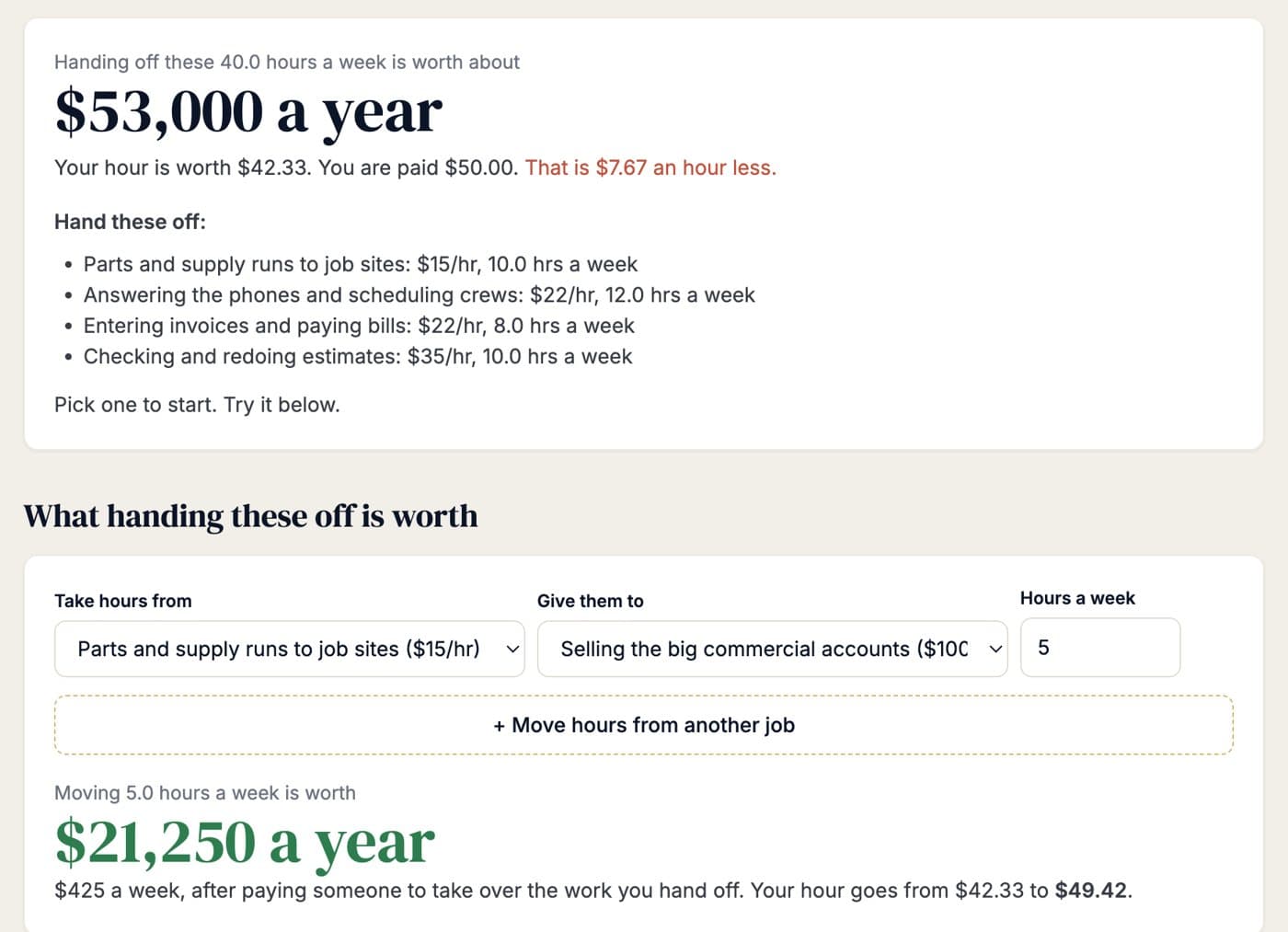
Take Gil, who owns an electrical contractor. Here is his week, priced.
Pecan Street Electric
Each bar is what one of Gil's jobs is worth per hour. The dashed line is what he pays himself.
Parts and supply runs to job sites $15 an hour, 10 hours a week
Answering the phones and scheduling crews $22 an hour, 12 hours a week
Entering invoices and paying bills $22 an hour, 8 hours a week
Checking and redoing estimates $35 an hour, 10 hours a week
Running the crew leads $60 an hour, 10 hours a week
Selling the big commercial accounts $100 an hour, 10 hours a week
Gil moves 5 hours a week from parts runs to selling the big accounts.
His hour today is worth about $42.
After the move, his hour is worth about $49.
That was Gil's week. Run yours, and change any number as you go.
Price my weekB10M is the AI-aided implementation of the 7 core plays that grow a company. A play is one part of the business to fix, like hiring, sales or accountability. You work on one at a time, never all seven.
The way of picking it is called The One-Play Method, and it has three steps: find the lowest one, move it up one level, repeat.
AI drafts the first pass of the work. You approve every step. Someone on your team can run it. It will not get you out of the building in a month. It moves one job at a time, at the pace your team can take on.
If you are weighing outside help to move those hours, start with whether it is built for a company your size.

The method is proven over 30 years in business and 17 years helping small companies.
Max Koz is the man behind B10M.
That is where the plays come from. None of it is a forecast for you.
This page has two goals. The first is to be useful even if we never talk: price your week and move a few hours off the lowest job yourself. The second is to show you where to go for help. Start with the tool, and book 15 minutes with Max if you want help after that.
Usually, yes, starting with the job furthest below what you pay yourself. Every hour on that job costs the business the difference. Put the hours you get back on your most valuable work, or they will fill up with more low work.
Pay about what the job is worth per hour, done well. The tool's starting guide runs from about $15 an hour for work anyone could do on day one to about $60 for work that needs a manager or an expert. Check pay where you are, and make sure the person produces more than they cost.
For a few jobs that is true, and those belong at the top of your list. For most jobs, the question is whether someone else does it well enough for what the job is worth. If a $22 job is one only you can do right, write down what good looks like so someone else can meet it.
Start with the math, not the hire. Paying someone for five hours a week of $15 work costs about $75 a week, and if those five hours go to work worth $100 an hour, the trade is easily worth it. If you cannot say where the hours would go, work that out first.
What you pay yourself is a choice, and often a low one, because you pay everyone else first. What your hour is worth comes from the jobs you do, not your paycheck. If none of your jobs reach the top of the guide, none of your hours go to winning the big account or setting prices.
They will be, and that is fine. A $15 job and a $100 job are far enough apart that a guess off by a few dollars does not change which one to move.
Sources checked October 20, 2026. The quotes are James Clear's own, and the stories are Max Koz's own. Everything else here, including the price guide, is our judgment, not a study and not a promise.
"Finally, divide your total money earned (Step 2) by your total time spent (Step 1)." And: "If you make $100,000/year, your time is worth $40.00/hour." He also names a "Cost-Based Method": "the rate you would pay someone else to do the work that you do."