Straight answers: problems

They Interviewed Great. Three Months Later, a Different Person.

Why the Interview Missed It, and How to See Who Someone Is Before You Hire

This page is for the owner whose best interview of the year turned into a hire he now checks every day.

It was the best interview you had all year. They had an answer for every question. They talked about owning their work and staying until it was done, and you called off the rest of the interviews that afternoon.

Three months later the work comes in late. You read everything they send before it goes out, because you have to. Some days it feels like a different person showed up for the job than the one who sat across the table from you.

If that is you, it does not make you a bad judge of people. The interview showed you a performance, and you judged the performance. Here is why that happens, how Max Koz looks for who someone really is before the offer, and where to start with the hire you already have. No personality test, no recruiter, and no firing on a hunch.

What one wrong hire costs you

The paycheck is the bill you can see, and it is the smallest one.

Then come the months. You give it a month, because everyone needs time to settle in. You give it another, because you are not sure. You give it a third, because you hate the thought of starting over.

Then the checking. You read their work before it goes out, and you redo the parts that are wrong. You hired them to get hours back, and now you spend those hours checking their work.

Your team is watching too. They saw it before you said it out loud. Some of them pick up the slack, and they notice how long it is allowed to go on.

Then you start over: the ad, the interviews, the same questions, and the same odds, because nothing about how you interview has changed.

Leadership IQ tracked 5,247 hiring managers from 312 organizations and found that "46% of newly-hired employees will fail within 18 months, while only 19% will achieve unequivocal success." It happens a lot. That does not make it cheaper when it happens to you.

If you are hiring to get your own hours back, first work out what your hour is worth.

Five things owners try, and what each still misses

Each one makes sense. Each one still judges what the person says in the room.

Better questions off a list online

You found a list of the best interview questions and asked them. The candidate found the same list. A good talker has a practiced answer for every one of them, so the better the list, the better the performance you get.

A personality test

It gives you words for how someone tends to act, and that has some use. But it is still the person describing themselves, filled in by someone who wants the job. It cannot tell you whether they finish the work when nobody is checking.

Trust your gut, and decide faster

Your gut is good with people you have known for years. In one hour with a stranger, it mostly measures how much you liked them. And the person easiest to like in an interview is the one who is best at interviews.

Reference calls

Worth doing, to check the facts. But the candidate picked the names, and a former boss who wants no trouble tends to say very little that helps you decide.

Hire slow, fire fast

Good advice, but it leaves something out. Slow against what? If nobody wrote down what the job needs, a slow hire is a longer look at the same performance. Firing fast just means you start over sooner.

If your real problem is that you added people and the questions still all come to you, read Why Hiring More People Didn't Fix It.

Why it happens: you judged the performance

Everyone brings their best self to an interview. They slept well, they dressed for it, and they practiced. That is not lying. It is what people do when they want the job.

The trouble is on your side of the table. You hear a good answer and believe it, because you need the job filled and the person in front of you sounds like the answer. You judged what they said. You never checked it against who they are.

Max does it the other way around. In his words: "You have to connect the dots, understand who they really are first." Who they are comes before what they can do.

Leadership IQ found the same thing from the other side. After tracking 5,247 hiring managers, it reported that "attitude drives 89% of hiring failures, while technical skills account for only 11% of hiring failures." The top reasons it named were coachability, emotional intelligence, motivation and temperament. Those are exactly the things a practiced answer covers best.

Max's four points for seeing who someone really is

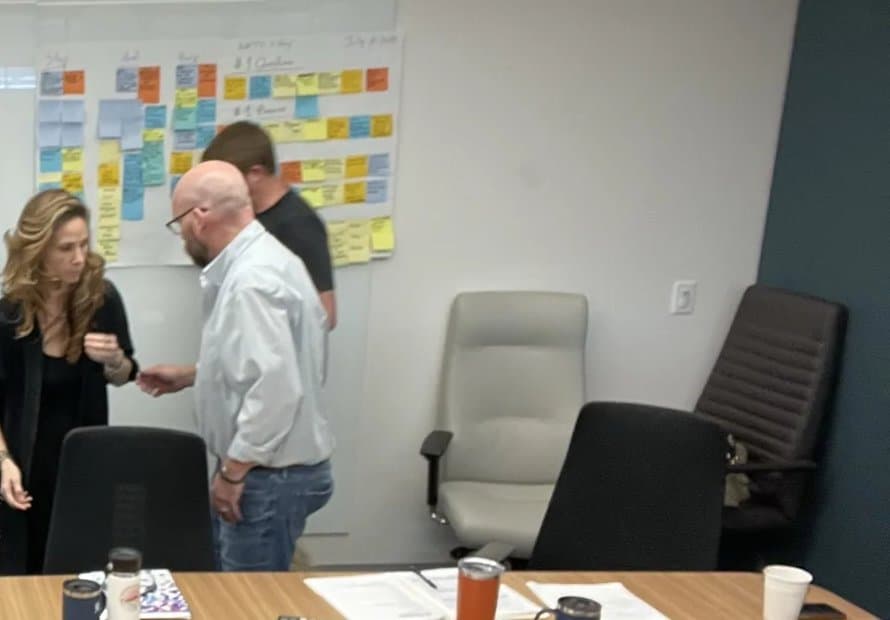
A bald man in glasses and a light shirt talks with a woman with long hair beside a whiteboard covered in colored sticky notes. Another man stands behind them, and a conference table with mugs and empty chairs sits in front.
A working session at the sticky note wall.

These are not a script. They are what Max listens for, in the order he uses them.

1. They bring their best self. Connect the dots.

Every candidate walks in as the best version of themselves. That is fine, as long as you know you are watching it.

So the question is not "is this a good answer?" It is "does this answer fit everything else I know about this person?" That is what Max means by connecting the dots: who they really are first, what they can do second.

2. Start with growing up

Max asks about life growing up: what they did, what they were responsible for, where their personality comes from. In his words: "I usually ask about life growing up, what they did. I ask about their personality and where it comes from."

A resume tells you where someone worked. It does not tell you who taught them to finish what they start. Habits are older than any job on the resume, and the story of where they came from is much harder to practice than an answer to "what is your greatest weakness?"

3. No story, no proof

They say "I'm a hard worker." Everybody says it. Ask where that comes from.

A real hard worker usually has a story: the job they took at fifteen, the shift nobody else wanted, the thing they paid for themselves. Max puts it plainly: "If it has no evidence or story, I doubt the validity." A claim with a story behind it is evidence. A claim followed by more adjectives is the performance again.

4. Listen for three things

Max listens for "what they say, don't say, and what they want me to believe."

What they say is the answer. What they don't say is the part of the story that should be there and is not, like why they left the last three jobs. What they want you to believe is the picture they are working hard to paint. When the picture is bigger than the facts behind it, slow down and ask again.

Rate the hire who changed first, then the people around them. The last question is one you have probably asked yourself already: would you hire them again?

Rate my team

What each way of checking a candidate shows you

Four of the things owners try, a working interview, and Max's way. Start with what each one misses.

Questions off a list online

What it shows you
How well they answer the common questions.
What it misses
Whether the answers are true. Good candidates have practiced them.
When it is the right call
To cover the basics and ask every candidate the same things.

A personality test

What it shows you
How they describe their own habits and style.
What it misses
Whether they do the work when nobody checks. They fill it in themselves, wanting the job.
When it is the right call
As one more input, never the deciding one.

Reference calls

What it shows you
Whether they worked where they said they did, and sometimes a hint of how it went.
What it misses
Most of the rest. The candidate picked the names, and many former bosses say very little.
When it is the right call
Every time, to check the facts.

Working interview or paid trial day

What it shows you
How they handle real work, for one day.
What it misses
Who they are by month three. Anyone can be at their best for a day.
When it is the right call
For hands-on jobs where good work is easy to see in a day.

Trusting your gut

What it shows you
How much you liked them.
What it misses
The difference between a good interview and a good hire.
When it is the right call
With people you have known for years, not a stranger after one hour.

Connect the dots (Max's way)

What it shows you
Who they are: where their habits come from, and whether their claims have stories behind them.
What it misses
It depends on you listening, not talking, and asking again. It still misses sometimes, and it does not replace a written job or a good first month.
When it is the right call
For any job where the person matters more than one skill, and you can swap list questions for follow-ups.
This is our judgment, not a study. Our own row lists what it misses too, and nothing here promises a result.

What no interview can fix

Two things go wrong that have nothing to do with the interview.

The first is a job nobody wrote down. If you never put on paper what the job needs, you had nothing to check the candidate against. You were comparing a good talker to a feeling. Before the next interview, write down what the job actually needs, in plain words.

The second is the first few weeks. Matt Palmquist, writing in strategy+business, reported on a study where "the authors studied 264 new employees at a major U.S. university." Each week over their first 90 days, the new hires rated how supportive their supervisors and co-workers had been, and those early attitudes "had a far more significant impact on their performance three months later". So not every change at month three is a bad interview. Sometimes it is a bad first month.

If you already hired them, do not fire on a hunch. Check whether anyone wrote down what the job needs, and whether they got real help in the first weeks. Then rate them, and answer the last question honestly: would you hire them again?

Connect the dots, write the job down, and give the first month real attention.

If the new hire keeps bringing the work back to you, read Why Everything Still Comes Back to You, Even With a Team.

Sample: two candidates, one question

Same question, two answers, both made up. Here is what Max listens for.

Sample

Office manager at Cedar Bend Plumbing, a made-up trades company

Cedar Bend Plumbing, Dana and Rick are made up. They are not clients and not real people.

Dana

Dana says:
“I'm a hard worker.”
Asked:
“Where does that come from?”
Dana:
“My dad had a small tire shop. From about twelve I opened it on Saturdays and ran the register. I paid for my first truck working there, and I kept his books until he sold it.”
What Max hears:
What she says has a story, with things you could check. What she does not say is that she loved it. She does not need to. What she wants you to believe is that she shows up and finishes, and the story backs it up.

Rick

Rick says:
“I'm a hard worker.”
Asked:
“Where does that come from?”
Rick:
“I've always just been that way. I'm driven, I'm detail-oriented, and I give everything I've got to whatever I do.”
What Max hears:
What he says is more adjectives. What he does not say is when, where or for whom. What he wants you to believe is that the words are enough. It might still be true, but there is nothing here to check, so Max asks again, and doubts it if no story comes.
Sample only: made up, not a client. One answer does not make a hire. It tells you where to ask the next question.

One play at a time

B10M is the AI-aided implementation of the 7 core plays that grow a company. A play is one part of the business to fix, like hiring, sales or accountability. You work on one at a time, never all seven.

The way of picking it is called The One-Play Method, and it has three steps: find the lowest one, move it up one level, repeat.

On this page, the play is hiring. AI drafts the first pass of the work. You approve every step. Someone on your team can run it. It will not fix every hire in a month. It moves one play at a time, at the pace your team can take on.

If you are weighing outside help with hiring, start with whether it is built for a company your size.

If the trouble is not a new hire but someone who has been loyal for years and is not getting it done, read what to do about a great guy who is not getting it done.

Where the method comes from

The method is proven over 30 years in business and 17 years helping small companies.

Max Koz is the man behind B10M.

That is where the plays come from. None of it is a forecast for you.

If you only read this part

  • The interview rewards the best talker. You judged the performance, not the person.
  • Connect the dots: find out who they really are before what they can do.
  • Ask about growing up and where their habits come from. A resume will not tell you.
  • No story, no proof. If "I'm a hard worker" has nothing behind it, doubt it.
  • Write down what the job needs before you interview, and give the first month real attention.

This page has two goals. The first is to be useful even if we never talk: ask your next candidate where their hard work comes from, and listen. The second is to show you where to go if you want help. Start with the Team Assessment. If you want help after that, apply.

Frequently asked questions

I already hired them. Now what?

Do not fire on a hunch. First check the job: did anyone write down what it needs, and does what they do today match it? Then check the first weeks: did they get real help, or a desk and a password? Rate them in the Team Assessment and answer the last question honestly: would you hire them again? If the job was clear, the help was there and the answer is still no, you know where you stand.

Isn't asking about growing up too personal? Is it even allowed?

Ask about what they did and where their habits come from: first jobs, chores, what they were responsible for, who taught them to work. Stay away from anything about age, family plans, religion, health and the like, and check the rules where you are. You are asking how they learned to work, not about their private life.

I don't have time for long interviews

You do not need a longer interview. You need a different twenty minutes. Swap a few list questions for follow-ups like "where does that come from?" and "when did that happen?" Next to three months of checking someone's work and starting over, it is a small trade.

Should I just use a personality test?

Use it as one input if you like. It tells you how someone describes themselves, filled in by someone who wants the job. It will not tell you whether "I'm a hard worker" has a story behind it. Only a conversation does that.

Is it me? Maybe I'm a bad judge of people.

Probably not. You judged what you were shown, and you were shown someone's best self. That happens to good judges of people too, because the job needs filling and the answer sounds right. The fix is not better instincts. It is checking what they say against who they are.

Does a working interview fix it?

It helps for hands-on jobs, because you see real work. But anyone can be at their best for a day. A trial day shows you skill. It does not show you who they are by month three. Use it with the conversation, not instead of it.

I'm too small to need a hiring process

In a small company, one hire is a big share of the team, and everyone sees what you put up with. You do not need a process with forms. You need the job written down in plain words and a few questions you always ask. That fits a company of any size.

Sources

Sources checked October 21, 2026. The quotes and numbers are theirs, and the method is Max Koz's, in his own words. Everything else here, including the chart, is our judgment, not a study and not a promise.

  • Leadership IQ: Why New Hires Fail (Emotional Intelligence Vs. Skills)

    "Leadership IQ tracked 5,247 hiring managers from 312 public, private, business and healthcare organizations." "46% of newly-hired employees will fail within 18 months, while only 19% will achieve unequivocal success." And: "attitude drives 89% of hiring failures, while technical skills account for only 11% of hiring failures." Top reasons: coachability (26%), emotional intelligence (23%), motivation (17%), temperament (15%), technical competence (11%).

  • strategy+business: Being Nice to New Hires Is Good for Business, by Matt Palmquist

    December 19, 2013. "The authors studied 264 new employees at a major U.S. university." Each week over the first 90 days, the new hires rated how supportive their supervisors and co-workers had been, and those early attitudes "had a far more significant impact on their performance three months later".