Straight answers: your coach

How Is This Different From the Coach You Already Have?

A Fair Test for What Your Business Coach or Fractional CFO Actually Leaves in Your Company

For the owner who already pays a business coach or a fractional CFO, likes them, and still finds every decision waiting on his desk.

It is Thursday at eleven and your monthly call with your coach just ended. It was a good call. You have three ideas on a legal pad: stop answering every text from the field, write down what a finished job looks like, and hold your managers to one weekly number. By two o'clock a manager is standing in your doorway with a customer problem, and the legal pad is under a pile of invoices. Next month you will tell your coach what you did not get to.

So you typed "do I need a business coach" or "is my coach even helping" into a search bar. Most of what came back was written by coaches, and it judges the coach. None of it asks what is left in your company when the call ends, or gives you a test you can run on your own week.

A good coach or a good fractional CFO can be worth keeping, and this page will not tell you to let anyone go. The difference is where the work lands. Advice lands in your head, and you still have to act on it. A play lands in the company, in writing, and someone on your team runs it. Below is a fair way to tell what your coach or your CFO is actually leaving in your company.

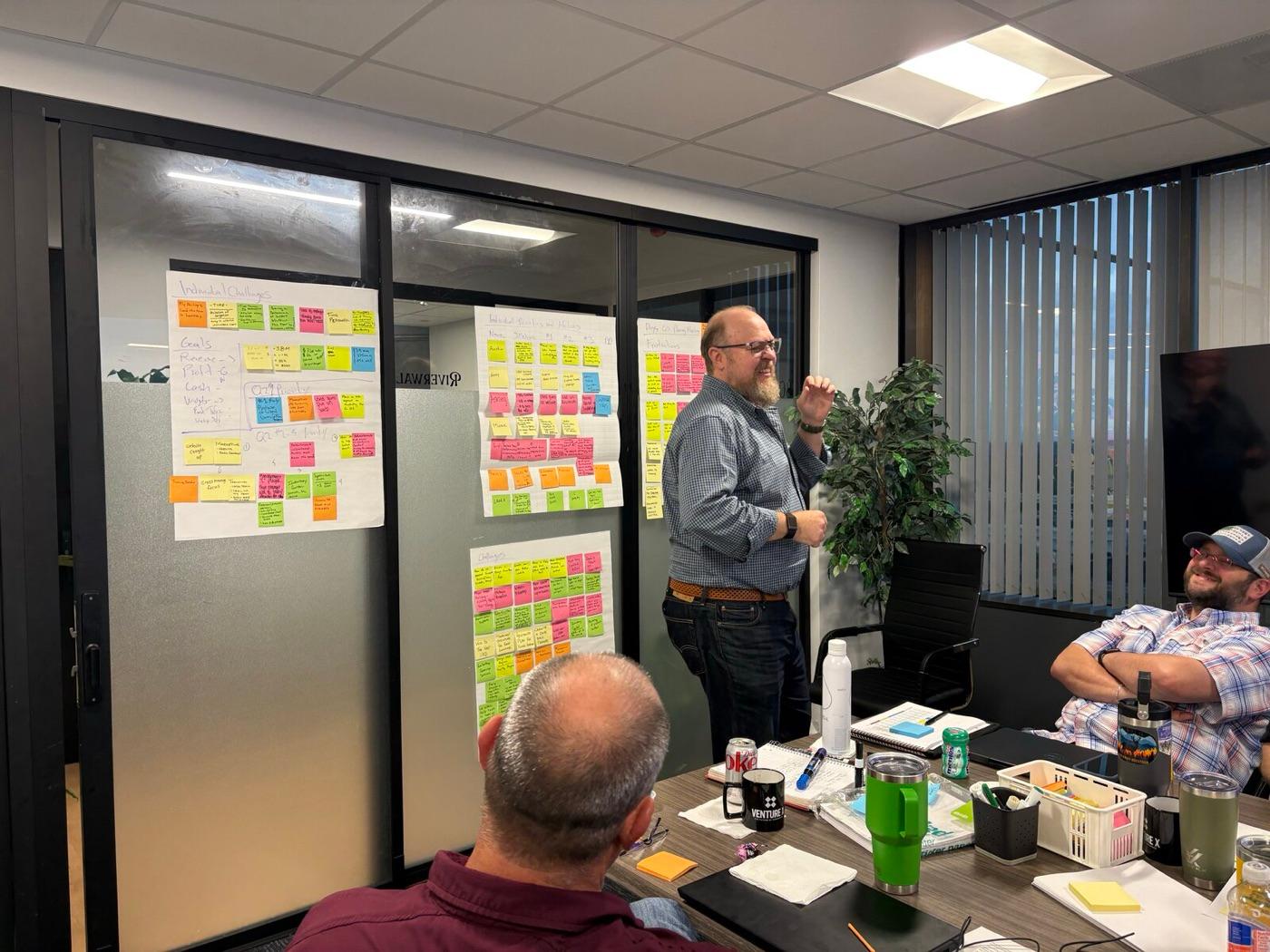
A bearded man in glasses stands at a conference table, laughing and talking with his hands, in front of glass walls covered with poster sheets full of colored sticky notes, while two men sitting at the table listen and smile.
Max Koz in a working session, with the work written up on the walls where everyone in the room can see it.

What it costs when good advice stays in your head, and a fair way to check

You pay every month for good ideas, and every idea lands on you. You have to remember it, turn it into instructions, tell the right person and check that it happened. Then the week fills up with quotes, calls and problems that walk into your office, and the idea waits for the next call.

Meanwhile the same things wait on you every week. Good people wait for your yes. The monthly call turns into a report of what you did not get to, and it starts to feel like your fault, or your coach's. Usually it is neither. The ideas were good, but every one of them landed on you, and your week was already full.

A fair test looks at what changed in your company, not at how good the calls felt. Pull up your notes from the last six months of calls, or the last six reports from your CFO. Answer these six questions honestly, and note which way each one points.

  1. First, list what came out of the calls. Write down every change you agreed to make in the last six months, big or small. If the list is short, count that as part of the answer, because ideas nobody wrote down rarely leave your head.
  2. Then mark where each item lives. Next to each one, write "lives in my head" or "the team runs it without me." Be strict here. If it only happens when you remember to push it, it lives in your head.
  3. Check what keeps running when you are gone. Take the items you marked "the team runs it" and ask whether they would keep going for two weeks with your phone off. If they would stop, move them to the other column.
  4. Ask who decides now. For each change, ask who makes the call today. If the answer is still you, the idea never left your head.
  5. Look at what you report on the next call. If most of each call is you explaining what you did not get to, the advice is landing on you and nobody else.
  6. Ask the same of your CFO's reports. Look at the last few and see how each one ends. If it ends with a next step and a name next to it, the advice is reaching the company. If it ends with a decision only you can make, it is reaching you.

None of this grades your coach or your CFO. A great coach can leave everything in your head, because helping you think is the job you hired them for. The test only shows where the work lands, and moving it is a job for you and your team.

If you are also weighing EOS, Scaling Up, Vistage or a fractional COO, read EOS, Scaling Up, Vistage, a Fractional COO, or Doing Nothing.

What owners usually try when the calls are not moving the company

Every one of these is a reasonable move, made by someone who wants the company to grow. Each one adds more advice or more people to hold it, and none of them changes where the work lands.

Adding a second coach

You figure a fresh voice will see what the first one missed, and sometimes it does. A new coach asks new questions, and that is worth something. But now two sets of good ideas land in the same head, and you have two calls a month to report what you did not get to.

More calls

You move from monthly to weekly so you stay on it. The calls get sharper and you feel more accountable. But you get more ideas and less time between calls to act on them, so the list of things waiting on you grows faster than it shrinks.

A bigger accountability group

You join a room of owners who will call you out when you slip. That keeps you honest, and the other owners often see things your coach does not. But the person being held to account is still you. Your managers were not in the room, so on Monday the work still starts with you.

Reading another book

Your coach recommends a book, and it is a good one. You underline half of it and bring three ideas to the next team meeting. Nobody was given a single one of them to own, so by the end of the month they are back on your legal pad with the rest.

Hiring a COO to hold it all

You decide the problem is that nobody turns advice into action, so you hire someone whose job is to do exactly that. Sometimes that is the right call. But if the standards still live in your head, the new person has to learn them from you one question at a time, and what they learn leaves with them if they go.

Is Your Fractional CFO Actually Giving You Good Advice?

Your fractional CFO's advice works the same way as your coach's. Advice lands in your head, and you still have to turn it into instructions, hand it out and follow up. A play lands in the company, in writing, and someone on the team runs it.

Here is what good advice from a CFO does, in four plain checks.

Good advice tells you what the numbers mean. A report full of numbers you cannot explain is not advice yet. You should be able to explain last month to your managers in two sentences after reading it.

Good advice says what to do next. It ends with one or two moves, not a page of things to watch. If every report leaves you wondering what to change, ask for the next step in writing.

Good advice names who on the team will do it. A next step with no name next to it becomes a next step for you. The best CFO reports come with a person attached to each move.

Good advice leaves something behind. Over six months, some of it should turn into a written routine, like a weekly cash check, that someone on the team runs without you or your CFO in the room.

If every report ends with you deciding alone, the advice may be fine and the company can still be stuck. That is not a reason to fire your CFO or your coach. They help you think, and that job is real. What is usually missing is the second job: something written down that the team runs when you are not in the room. The two can work side by side.

One owner sorts six months of calls

Sample

Luis's six takeaways, and where each one lives

Luis and his company are made up. He is not a client, and nothing here is a result. He is here to show how the test reads, so you can run it on your own notes.

Luis owns a residential plumbing company with 22 people and two service managers. He has paid a business coach for monthly calls for two years, and he likes him. His fractional CFO sends a report every month. One evening he pulled his notes from the last six months of calls and marked each takeaway:

  1. Raise the price on after-hours calls: the team runs it. The new rate is on the price sheet the dispatchers use, so nobody asks Luis about it anymore.
  2. Stop answering every text from the field: lives in my head. He meant to, and he still answers about 40 a day, because nobody was told which questions they could answer themselves.
  3. Hold a weekly meeting with both service managers: lives in my head. The meeting only happens when Luis calls it, and it was skipped four of the last eight weeks.
  4. Write down what a finished install looks like: lives in my head. He knows exactly what good looks like and still checks every install photo himself. Nothing is on paper.
  5. Hire a second dispatcher: the team runs it. She started in June, and the office manager trains her from a written checklist.
  6. Look at margin by job type every month: lives in my head. The CFO sends the numbers, and Luis reads them alone at night. Nobody else sees them, and no report names who should act on them.

Two of the six ran without him. Four lived only in his head, and three of those four were the same kind of thing: a standard Luis knew by heart that nobody else had ever been given.

So his coach was not the problem, and Luis kept the calls. They were giving him good ideas. What was missing was a written standard the team could run, starting with what a finished install looks like, so one service manager could check installs instead of Luis.

The test did not write the standard for him, and it did not tell him whether that service manager was ready. Luis still had to decide that himself.

It shows how the test works on one made-up company, not what yours will show.

Want your own read instead of a made-up owner's? The CEO Tune-Up takes about two minutes and names the one play to work on next.

Run the CEO Tune-Up

The One-Play Method

B10M (Beyond 10 Million) works on the seven parts of a company that make it grow: leadership, focus, hiring, marketing, sales, accountability and innovation. You work on one at a time, never all seven.

The way of choosing which one is called The One-Play Method, and it has three steps: find the lowest one, move it up one level, repeat.

When an owner already pays for advice, the lowest one is often accountability, because the standard lives only with him, or focus, because his week goes to everyone else's questions. Moving it up one level is meant to be a small step. If most of your takeaways said "lives in my head," it might mean writing down one standard so one person on your team can run it without you. You keep the calls if they help, and you do not redo the whole company. Once that one thing holds, you look at what is lowest next.

You probably already know which takeaway keeps waiting on you. The CEO Tune-Up takes about two minutes and names the one play to work on next, so you can check your guess against it.

Run the CEO Tune-Up

What each kind of help gives you, and where the work lands

Here is each kind of help by what it gives you, where the work lands once it is done and what it still leaves for you.

A business coach

What it gives you
Someone outside the company who helps you think, spots patterns and asks the hard question
Where the work lands
In your head, as ideas you still have to turn into instructions
What it still leaves
Writing it down, handing it out and following up, which is still your job

A fractional CFO

What it gives you
Numbers you can trust and a read on what they mean
Where the work lands
In a report, usually on your desk
What it still leaves
Who on the team acts on it, unless the advice names someone

A peer group

What it gives you
Perspective from owners who have been there, and a room that keeps you honest
Where the work lands
In your notebook, as other owners' answers for their own companies
What it still leaves
Your team, who were not in the room

Doing it alone

What it gives you
No new bill, and you choose what to read and try
Where the work lands
In your head, along with everything else
What it still leaves
The time to act on any of it, and nobody to check your thinking

Plays your team runs

What it gives you
One part of the company written down so someone other than you can run it
Where the work lands
In the company, in writing, with a name next to it
What it still leaves
It will not talk a hard week through with you. It works on one part at a time, so the rest waits. Someone on your team has to find the time to run it, and you still approve each step.

A business coach gives you someone outside the company who helps you think, spots patterns and asks the hard question. The work lands in your head, as ideas you still have to turn into instructions. It leaves writing it down, handing it out and following up, which is still your job. A fractional CFO gives you numbers you can trust and a read on what they mean. The work lands in a report, usually on your desk. It leaves who on the team acts on it, unless the advice names someone. A peer group gives you perspective from owners who have been there, and a room that keeps you honest. The work lands in your notebook, as other owners' answers for their own companies. It leaves your team, who were not in the room. Doing it alone costs you no new bill, and you choose what to read and try. The work lands in your head, along with everything else. It leaves the time to act on any of it, and nobody to check your thinking. Plays your team runs give you one part of the company written down so someone other than you can run it. The work lands in the company, in writing, with a name next to it. They will not talk a hard week through with you, and they work on one part at a time, so the rest waits. Someone on your team has to find the time to run the play, and you still approve each step.

This is our judgment, not a study, and none of these rows were measured. Our own row still leaves real work: it will not talk a hard week through with you, the rest of the company waits while one part moves, and someone on your team has to find the time to run it.

Where the method comes from

The plays behind this page are proven over 30 years in business and 17 years helping small companies. Max Koz is the man behind B10M.

That record belongs to the method, not to the six-question test. The test's proof is simpler, and you check it yourself: run it on your last six months of notes and see whether the read matches the company you run.

Nothing on this page is a forecast for your company, and we are not promising a result.

Run the CEO Tune-Up on your own company and judge the play it names yourself.

Run the CEO Tune-Up

The short version

  • A good coach or fractional CFO can be worth keeping. The real question is what their advice leaves in your company when the call ends.
  • Advice lands in your head, and you still have to act on it. A play lands in the company, in writing, and someone on your team runs it.
  • The fair test: list six months of takeaways and mark each one "lives in my head" or "the team runs it without me."
  • Good CFO advice tells you what the numbers mean, says what to do next and names who will do it. If every report ends with you deciding alone, the company can still be stuck.
  • Another coach, more calls, a bigger group, another book or a COO to hold it all each add advice or people, and none of them changes where the work lands.

We wrote this for two reasons. The first is to be useful even if we never talk: mark your last six months of takeaways, keep the help that is helping and write down the one thing that keeps waiting on you. The second is to show you where to go if you want help. Run the CEO Tune-Up first. If you want help after that, apply for a fit review with Max Koz.

Frequently asked questions

I like my coach. Do I have to choose?

No. If the calls help you think, keep them. Your coach helps you decide, and a written play is what the team runs after you decide, so the two do different jobs. The test on this page is not about whether to keep your coach. It shows you which of the good ideas never left your head.

Is my fractional CFO actually giving me good advice?

Look at the last three reports. Good advice tells you what the numbers mean, says what to do next and names who on the team will do it. If every report ends with you deciding alone, the advice may be fine and the company can still be stuck. Ask your CFO to put a next step and a name on each one, and see what changes.

How do I know if my coach is actually helping?

Run the test on your last six months of notes. If a fair share of the takeaways now run without you, the calls are paying off in the company. If almost all of them still live in your head, your coach may still be helping you think well, and the missing piece is getting the ideas out of your head and into writing. Either way, whether to keep the calls is your call.

I tried EOS and it did not stick.

That happens to owners who worked hard at it. A full program asks a company that already waits on its owner to take on many new habits at once, and most of those habits end up waiting on the owner too. Here you pick one part, put it in writing and give it to one person, and leave the rest alone until that holds.

I am too small for this.

If you pay someone for advice and the ideas still wait on you, you are not too small. With little or no team, the full plays often come too early, because there is nobody else to run them yet, and we would rather say so. Start with the CEO Tune-Up, which reads you and not the size of your company.

I don't have time for one more thing.

Then do not add one. The six questions use notes you already have and take one evening, and the CEO Tune-Up takes about two minutes. The point of a play is to take something off your week by putting it in writing so someone else runs it.

Isn't this the same thing with a different name?

No, and the difference is easy to check. Advice is something you hear and then have to act on. A play is a written piece of the company, like what a finished job looks like or how the weekly cash check works, that someone on your team runs without you. B10M is the AI-aided implementation of the 7 core plays that grow a company. The plays are proven over 30 years in business and 17 years helping small companies. B10M finds the few things you have to do next, and you and your team run the work at your own pace.

If the question underneath this one is whether the problem is you, read Am I the Problem in My Business?.

Sources

Checked November 22, 2026. This page cites no outside sources and no studies. Where it mentions what other articles on this question say, that is our general read of what comes up in a search. Everything else, including the test, the chart and the sample, is our judgment, not a study and not a promise.